

Explained
What Bitcoin ETF flows really measure (and what they don't)
A daily ETF flow is the change in shares outstanding times NAV. Here is how that number is made, when it arrives, and why a big inflow is not the same as a big buyer.
Whale transfers, liquidations, new listings, funding extremes and macro prints. Posted the moment they cross a public threshold, with the source and the UTC time on every card.
Information, not investment advice. Crypto-assets are highly volatile and you can lose all the money you put in.
Not the big names. Whatever crossed the line that minute, up or down, got the same card.
Five arrive on a clock, so you always know when to look. Nine fire only when something crosses a line we publish. Drag the deck, or tap a candle to jump; the front card opens full size.
Candle height = how often it postsTap a candle to jump
An example Monday, with the real clock on top. Diamonds are fixed times; dots are triggers, so a quiet day has fewer and a wild one has more, up to about twenty posts.
Spot price, the last 24 hours and the last 30 days. Tap a coin for its page: chart, price on five exchanges, whitepaper, team and links.
Loading the whole market
Loading
Loading
Loading
Six meme coins with the deepest markets, read from the same feeds as the big ones.
Memes have no earnings and no product to value. Their price moves on attention, double-digit days are normal, and most meme coins end up losing almost everything. Being on this list is not a recommendation; it only means the market is big enough to report on.
Every live number on this site comes from one of these public APIs. Prices are at most two minutes old; coin profiles at most six hours.
 BinanceSpot price, and the 24 h change and daily candles whenever it answers
 CoinbaseSpot price in US dollars, and the ticker’s backup
 KrakenSpot price in US dollars
 OKXSpot price, and the 24 h change and daily candles when Binance doesn’t answer, which is most of the time
 BybitSpot price
 CoinPaprikaCoin profiles: description, team, whitepaper, links, market cap, supply, all-time high, and the total market cap with Bitcoin’s share
 CoinGeckoThe prices in the ticker at the top of the page, and the market totals if CoinPaprika doesn’t answer
 CoinLoreThe market totals if neither CoinPaprika nor CoinGecko answers
 Alternative.meThe Crypto Fear & Greed Index and its last 30 days
 mempool.spaceBitcoin block height, block time and fees, for the halving countdown
Live headlines from four newsrooms, newest first. Each one links to the editor who wrote it; we never rewrite their story.
Every card has the same six parts in the same places. Once you know them you stop reading and start scanning.
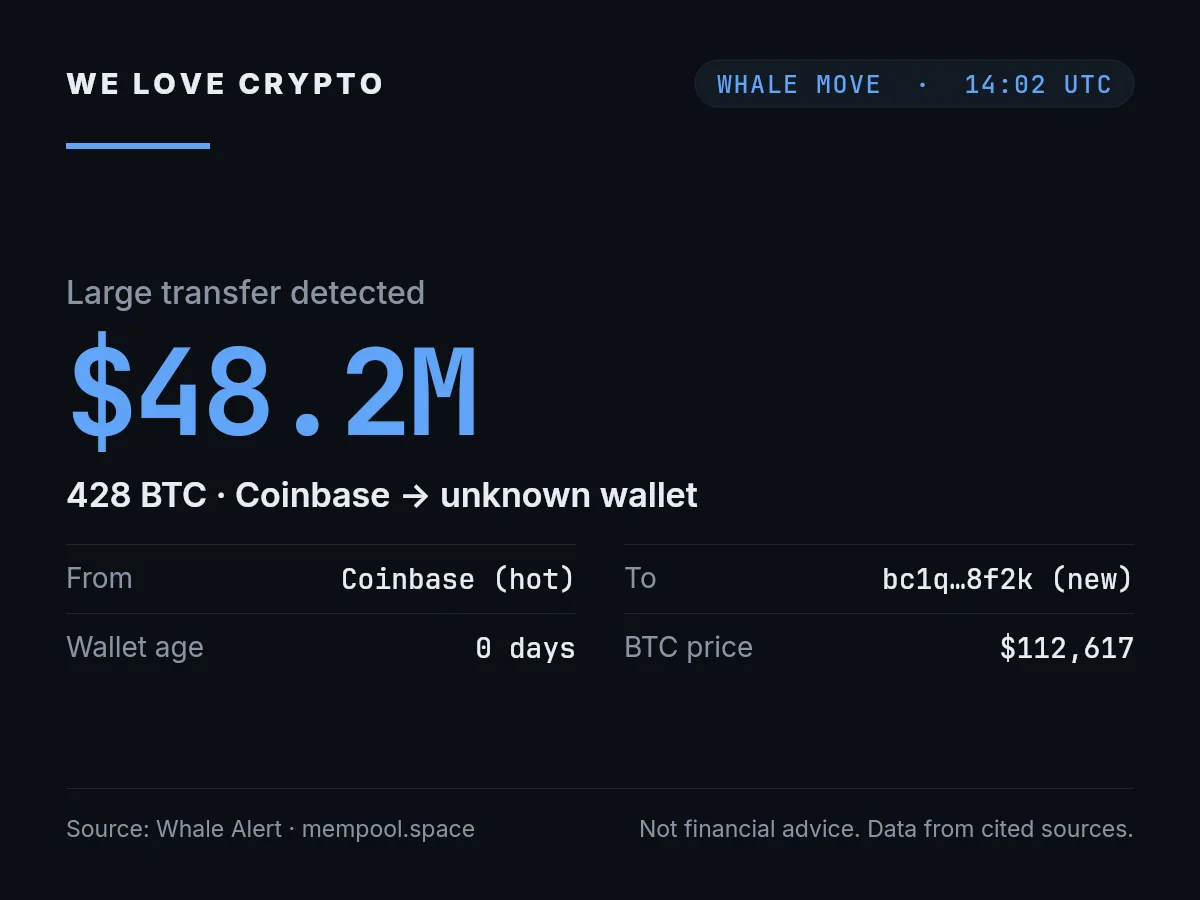
Top right, always. The colour tells you the kind of news before you read a word: blue for money moving, red for money lost, amber for price and funding, green for new listings, teal for unlocks, violet for new pairs, grey for macro and white for the scheduled posts.
The single figure that made the post fire, set large in mono so the digits line up.
Who moved what, from where to where. Plain words, no adjectives.
Four figures that let you judge size for yourself: where it came from, where it went, wallet age, price.
Whale Alert, Coinglass, exchange APIs, the BLS. If we can’t name a source, the card doesn’t go out.
“Not financial advice. Data from cited sources.” On every card, in the same place.
We post what happened and how big it was. Opinion stays in the two daily briefings and is labelled as such.
We never tell you what to trade or when. No price targets, no entry points, no countdowns.
Every trigger has a rule you can read on this page. If it didn’t cross the line, it doesn’t get a post.
Projects can’t pay to appear on the channel. Partner links are labelled and explained in the FAQ.
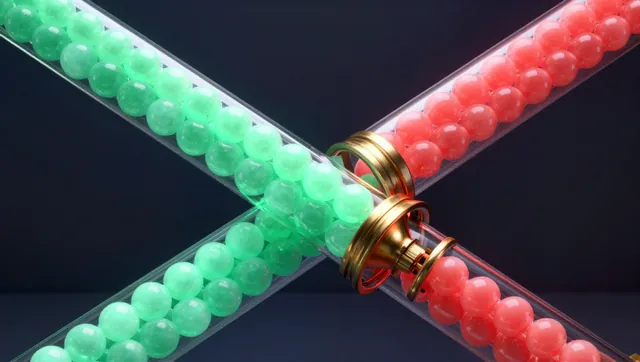
Our logo is two candles: one green, one red. Together they make a heart. A pump and a crash get the same card, the same size and the same calm sentence.
The channel is new, so this is empty for now. We would rather show a zero than a quote we wrote ourselves.
When members write them, they will appear here, good and bad, with the date they were written.
Write a review on TelegramEvery review comes from someone in the channel. No stock photos, no invented names.
No money, no discount, no giveaway in exchange for a review.
Published as written. We don’t trim, polish or pick the nice half.
A one-star review goes up next to the five-star ones.
Short answers to what people ask most.
Yes. Joining and reading the channel costs nothing. There is no paid tier.
No. We report what moved, by how much and according to whom. We never tell anyone to open, close or hold a position, and nothing on the channel is investment advice. What you do with the information is your decision.
It’s an affiliate link: if you open an account through it, we may earn a commission. That’s how the channel stays free. It never changes what we post or how we write it.
In the EU and EEA the button goes to Bybit EU GmbH, licensed under MiCA in Austria. In countries where we can’t offer a licensed option, there’s no button. New Pair posts never carry a button, because those tokens trade on decentralised exchanges and a button there would read as a recommendation.
Between 10 and 20 a day. Two briefings at 08:00 and 20:00 UTC, ETF flows after the US close, two weekly posts, and the rest only when a threshold is crossed. Mute the channel if you’d rather check in on your own time.
Crypto runs on UTC: funding windows, ETF reports and exchange listings are all announced in it. Use the My time switch in the day timeline above to see the schedule in your own time zone.
From named public sources: exchanges like Bybit and Binance, on-chain trackers like Whale Alert and mempool.space, Coinglass for derivatives, Farside for ETF flows and the US BLS for macro. Each card prints its source at the bottom left.
High, by design. A New Pair card reports a fresh token and the on-chain checks we can run: liquidity locked or burned, mint authority revoked, how much the top 10 wallets hold. Passing those checks doesn’t make a token safe.
Guides, definitions and the stories behind the cards, written by the We Love Crypto Desk.
A daily ETF flow is the change in shares outstanding times NAV. Here is how that number is made, when it arrives, and why a big inflow is not the same as a big buyer.

The same BTC long on the same account, run once in cross mode and once in isolated mode: where each liquidates, what each can cost you, and when to pick which.
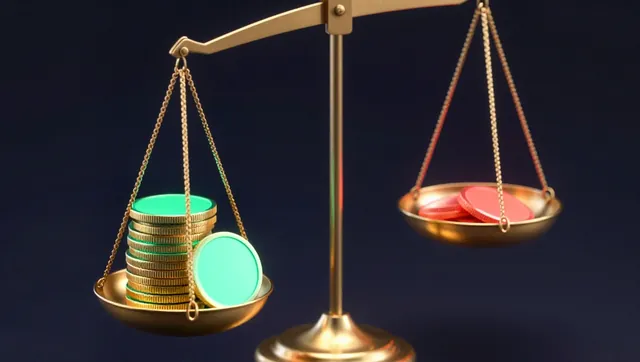
The small payment that keeps a perpetual future close to spot: who pays it, how it is set, what it costs you, and why an extreme reading is about positioning, not direction.

A liquidation is the exchange closing your leveraged position because your margin ran out. Here is where the line sits, what moves it, and how one forced sale turns into many.

A lock keeps the pool in place until a date; a burn keeps it there for good. Neither stops a fresh mint, a sell block or a large holder selling. Here is how to read both.




Three of the largest memecoins in one table, read from the CoinGecko API on 27 Oct 2026, with what the numbers measure, what they leave out and the risks that sit outside the table.
Free, in English, 10 to 20 cards a day, each with its source and UTC time. Mute it or leave whenever you like.
On a computer?
Scan with your phone.